
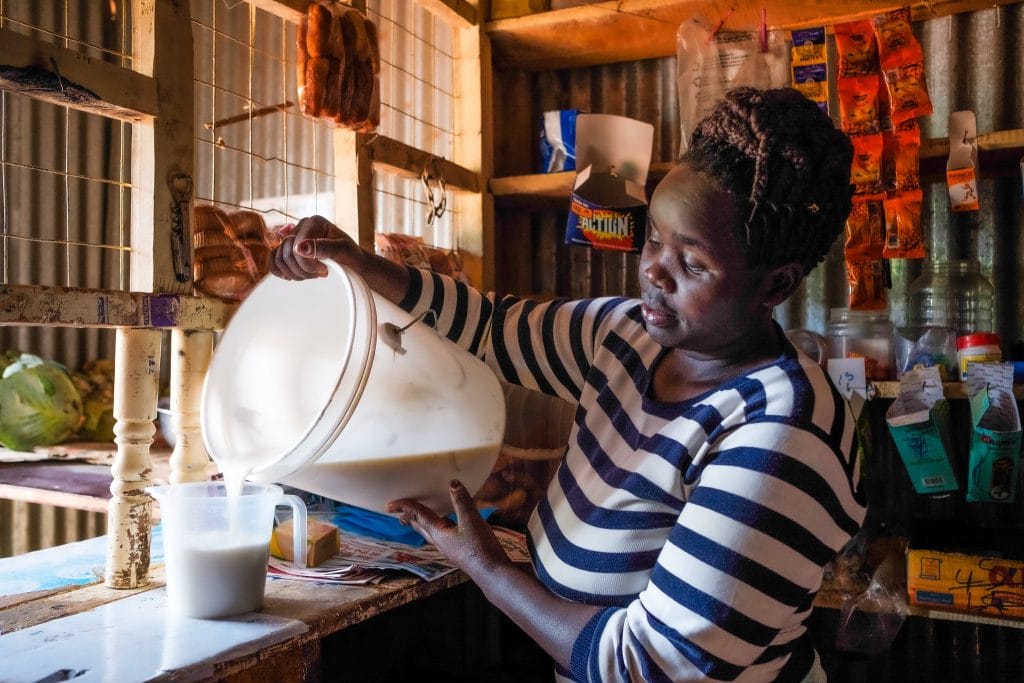
The Dairy Interventions for Mitigation and Adaptation (DaIMA) programme, led by the International Fund for Agricultural Development (IFAD) and backed by a $150 million co-financing commitment from the Green Climate Fund (GCF), marks the first large-scale climate funding initiative of its kind directly targeting dairy systems.
The programme is set to directly benefit 2.5 million rural people in Kenya, Rwanda, Tanzania, and Uganda, with an additional 15.4 million individuals impacted indirectly along the dairy value chain.
“The dairy sector is central to food security and livelihoods in East Africa but faces mounting pressure from climate change,” said Sara Mbago, IFAD’s Regional Director for East and Southern Africa. “DaIMA is about transforming the backbone of East Africa’s dairy sector. By combining innovation, investment and policy reform, we are helping farmers adapt to a changing climate while reducing emissions.”
A Sector Under Pressure
The East African dairy sector, a vital source of nutrition and income, is increasingly vulnerable to heat stress and drought. The DaIMA programme aims to address this by strengthening the productivity and efficiency of production systems, which in turn reduces greenhouse gas emissions per unit of milk produced.
Scaling Solutions
Already operational through four existing IFAD projects, DaIMA will equip smallholder farmers with climate information, improved breeding and veterinary services, and innovative technologies for feed and manure management. Key activities include restoring nearly 180,000 hectares of degraded rangeland and supporting over two million dairy cattle.
A dedicated Green Dairy Financing Facility will be established to unlock further climate finance for farmers, cooperatives, and small businesses.
Ambitious Targets and a Coalition of Partners
The programme has set clear, measurable goals: a projected 34 percent increase in milk production and a reduction of 2.1 million tonnes of CO₂ equivalent over 20 years.
DaIMA’s preparation brought together a powerful coalition, including the International Livestock Research Institute (ILRI), the FAO Investment Centre, the Global Methane Hub, the Global Dairy Platform, and USAID.
ILRI, through its Mazingira Centre, will serve as a regional hub, providing technical assistance on Monitoring, Reporting, and Verification (MRV) of greenhouse gas emissions.
“DaIMA represents a major milestone,” said Appolinaire Djikeng, Director General of ILRI. “By scaling up low-emission, climate-resilient solutions, DaIMA directly supports the implementation of the Paris Agreement, accelerating the sustainable transformation of the dairy sector in the region.”
With a strong emphasis on including women, youth, and marginalized communities, DaIMA is positioned as a blueprint for linking finance, innovation, and policy to build a climate-smart agricultural future in East Africa.